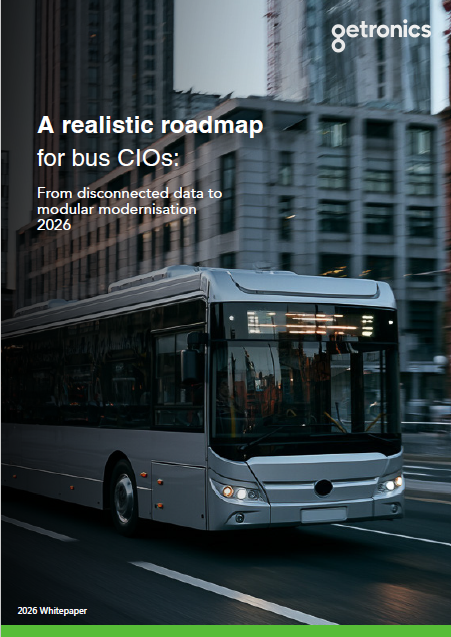
Whitepaper: a realistic roadmap for bus CIOs - from disconnected data to modular modernisation
Bus operators already have the data passengers are asking for, the problem is getting it out of disconnected legacy systems. This whitepaper breaks down a bimodal approach to modernising without disrupting service, and links to the full roadmap for CIOs ready to close the gap.

Passengers are asking bus operators for things the data already supports. In Getronics' recent Bus Tracker survey, 69% of Brits said technology changes would make them more likely to use the bus, and they were specific about what they want: 55% want accurate live route information, 53% want to check occupancy before they travel, 52% want better fleet communication, 51% want journeys that connect across transport modes, and 50% want to plan and book through an app.
None of this is science fiction. Tracking systems, ticketing platforms, driver systems, maintenance tools and passenger information systems already hold the data needed to deliver it. The problem isn't a lack of insight — it's that these systems were bought separately over the years, run on different architectures, and in many cases can't share information with each other at all.
Why legacy systems stay in place
Most bus CIOs already know this. What keeps ageing systems running anyway is a familiar set of pressures:
Cost of change. Building a business case for an overhaul is hard when the existing systems still technically work.
Risk of operational disruption. Migration raises the spectre of downtime, data loss, or integration failures that hit scheduling, fare collection and passenger information — so teams stick with what they know.
Limited in-house expertise. Deep operational knowledge doesn't automatically translate into the technical capability to lead a system overhaul.
Fear of "rip and replace." Many operators assume modernisation means starting from scratch, and that assumption alone is often enough to stop a project before it starts.
These are reasonable barriers, but leaving legacy systems untouched isn't a neutral choice. Running costs keep climbing, cybersecurity exposure grows, and the gap between what passengers expect and what operators can deliver widens every year the decision is deferred.
A bimodal approach
Modernisation doesn't have to mean an all-or-nothing overhaul. A bimodal approach splits the work into two streams that run in parallel:
Mode 1: protect the operational core. CAD/AVL platforms, scheduling engines and fare collection infrastructure get incremental, low-risk upgrades within planned maintenance windows, with stability as the primary metric — while internal teams are upskilled to carry the work forward.
Mode 2: accelerate passenger-facing innovation. Cloud-based platforms can deliver improvements like real-time passenger information in weeks rather than years, without the cost or risk of replacing entire systems. Success here is measured by passenger response.
Run together, this means the legacy dispatch system keeps the daily operation running while modern platforms layer on top to transform what passengers actually experience.
Rolling out without disrupting service
The guiding principle for any rollout is simple: passengers should experience improvements, not disruptions. In practice, that means:
- Using existing maintenance windows and pilot vehicles before fleet-wide deployment
- Running new systems in parallel rather than switching over abruptly
- Starting on lower-frequency routes, where the stakes of early issues are lower
- Training staff before passengers see any change, and communicating proactively where they will
- Building in fallback options so any issue can be rolled back without passenger-facing disruption
Cloud-based platforms make this easier from the start, since remote data processing removes the need to install and configure complex onboard computers.
Where specialist support fits
Operators know their routes, passengers, schedules and platforms better than anyone. But understanding what technology should achieve is different from knowing how to implement, integrate and troubleshoot it — and that's rarely a skill in-house teams have at the scale a modernisation programme needs.
The projects that work well are the ones where this is structured deliberately: internal teams own the operational requirements and day-to-day management, while a specialist partner handles implementation, integration, and the transfer of skills the internal team needs to run and evolve the systems afterwards. Done well, passengers simply notice that arrival predictions are more accurate, the app works better, or the operator responds faster when something goes wrong.
Start with an honest assessment
The real question isn't about the technology, it's whether the organisation can deliver the service passengers are asking for, and the systems are only the means to that end. The first step is understanding what data you already have, where the gaps are, and which passenger-facing improvements should come first.
Download the full whitepaper, A realistic roadmap for bus CIOs: From disconnected data to modular modernisation, for a closer look at the systems that need to connect, the bimodal model in practice, and a rollout checklist you can apply to your own fleet.